
Written by DofE Skills Programme Lead at Education Direct Worldwide, who designs and supervises the Bronze, Silver and Gold AI & Digital Entrepreneurship curriculum. Reviewed by Education Direct Worldwide's DofE Programme Team. Published 6 August 2026 · Last updated 6 August 2026.
Artificial intelligence is now one of the most common questions asked by DofE participants, parents and Leaders: can AI be used for the DofE Skills section, and if so, what does an acceptable AI DofE activity actually look like?
This guide answers that directly, then shows real weekly structures, ten AI DofE project ideas, evidence examples and Bronze, Silver and Gold timelines drawn from a Skills programme delivered by a DofE Approved Activity Provider.
---
The short answer
Yes, artificial intelligence can be used as a DofE Skills section activity when the participant follows a structured programme, develops their ability over the required period and produces evidence of regular progress. AI activities could include prompt engineering, responsible AI use, digital content creation, no-code app development or an AI-supported entrepreneurship project. Participants should agree their chosen activity and goals with their DofE Leader before starting.
---
1. Can artificial intelligence count for DofE Skills?
Yes — artificial intelligence can count for the DofE Skills section, provided it is treated as a skill to be developed, not a shortcut to be used.
The Skills section exists so that a young person can broaden their interests and improve a practical ability over a sustained period. That principle is what decides whether an AI activity qualifies:
- Occasionally asking ChatGPT to write something is not a Skills activity. There is no progression, no measurable improvement and nothing meaningful to evidence.
- Learning to design, test and refine AI-supported work each week is a Skills activity. Prompt engineering, responsible AI use, AI-assisted design, no-code building and digital entrepreneurship all improve with deliberate practice.
The test to apply is simple: if a participant compares their work in week one with their work in the final week, is the difference visible? If yes, the activity is developing a genuine skill.
As with any Skills activity, the participant's programme, goals and assessor arrangements should be agreed with their DofE Leader before starting, and recorded in eDofE.
---
2. What does an AI DofE activity involve?
A credible AI DofE activity runs on a repeating weekly learning cycle:
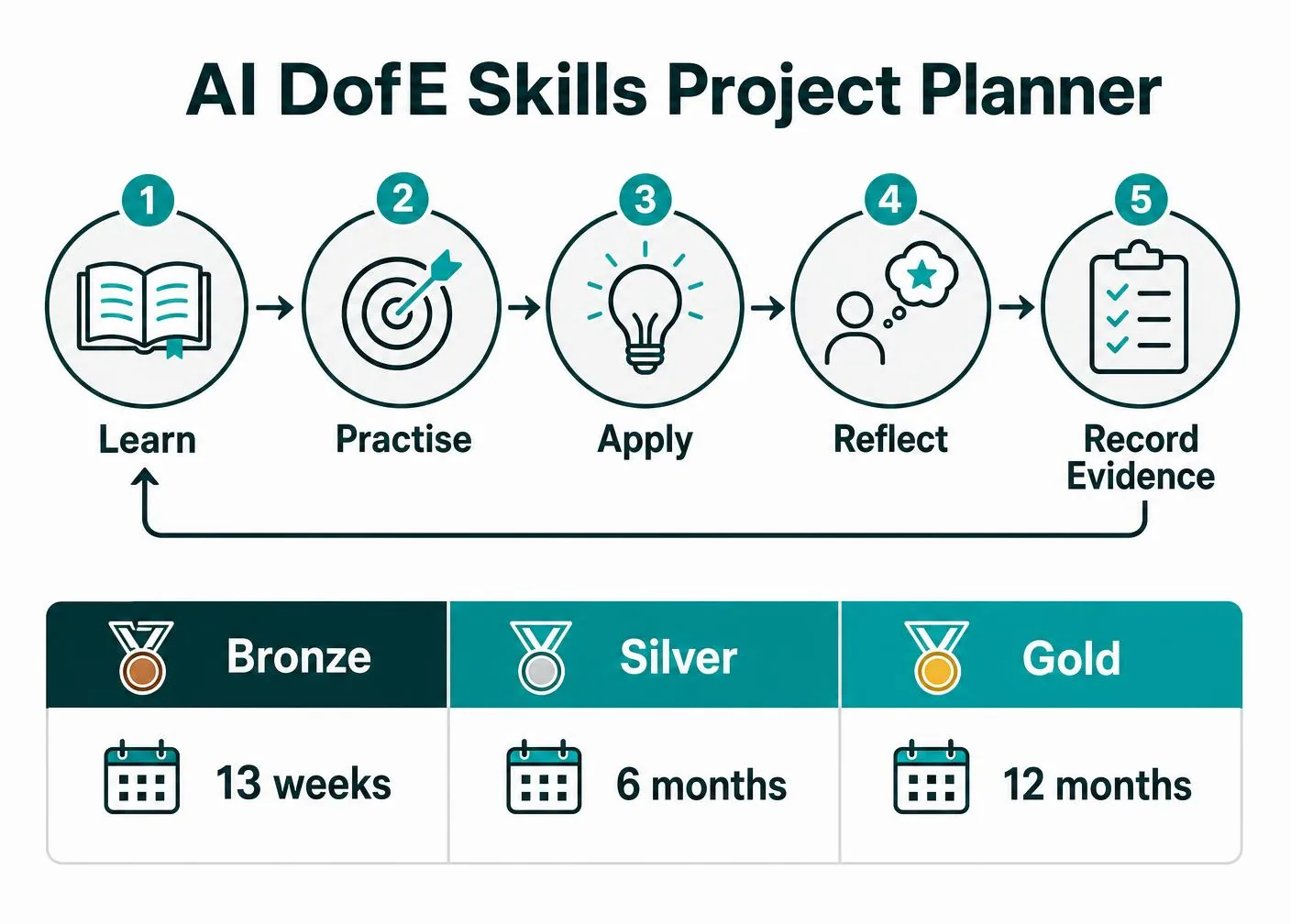
Learn → Practise → Apply → Reflect → Record evidence
| Stage | What the participant does each week | Typical time | | --- | --- | --- | | Learn | Study one focused topic — AI fundamentals, bias, branding, market research, prototyping | 20–30 minutes | | Practise | Try the technique deliberately: rewrite prompts, test a design, run an interview | 20–30 minutes | | Apply | Move the personal project forward by one concrete step | 30–40 minutes | | Reflect | Note what worked, what failed and what changes next week | 5–10 minutes | | Record evidence | Save logs, screenshots, drafts and feedback for eDofE | 5 minutes |
Most participants complete this in around one hour a week, which matches the usual expectation for a Skills activity.
Free download: Weekly Evidence Checklist (PDF) — a one-page printable sheet covering Learn, Practise, Apply, Reflect and Record Evidence, plus space for assessor notes.
---
3. Ten AI project ideas for DofE Skills
Each idea below can be run at Bronze, Silver or Gold — the difference is depth, duration and how much leadership and impact the participant demonstrates.
1. Create an AI-supported awareness campaign — choose a cause (online safety, mental health, climate), research the audience and build a campaign with AI-assisted copy, visuals and a distribution plan. 2. Design a no-code website or app prototype — turn an idea into a working prototype using no-code tools, testing navigation and layout with real users. 3. Develop a digital business idea — validate a problem, research competitors, price the offer and produce a one-page business model. 4. Produce an AI-assisted podcast — plan episodes, script with AI support, record, edit and publish a short series. 5. Build a prompt engineering portfolio — document prompt patterns, before-and-after outputs and what made each version better. 6. Design a responsible AI guide for students — write a practical guide covering verification, privacy, bias and academic honesty for your school or youth group. 7. Create a digital brand and marketing campaign — develop naming, logo, tone of voice and a content calendar, then measure engagement. 8. Research AI bias and misinformation — run structured tests on AI outputs, record where they fail and present your findings. 9. Develop an AI-powered study-support concept — design a revision tool or workflow that helps peers learn, then test it with them. 10. Solve a community problem through digital innovation — identify a local need, interview people affected and prototype a digital solution.
Looking for non-AI options too? Browse our 60+ DofE Skills ideas by category.
---
4. Bronze AI DofE project example
This is a realistic 13-week Bronze structure, taken from the Education Direct Worldwide Bronze curriculum (delivered over 3 or 6 months, depending on the plan agreed with your DofE Leader).
| Week | Focus | Evidence produced | | --- | --- | --- | | 1 | Programme orientation and goal setting | Written Skills goals and project entry | | 2 | Digital literacy and online safety | Personal safety checklist | | 3 | Introduction to artificial intelligence | AI exploration notes | | 4 | AI for creativity | An AI-assisted creation with your own edits | | 5 | Problem identification | A clear problem statement | | 6 | Entrepreneurship fundamentals | Idea description | | 7 | Market research | Research notes and audience insight | | 8 | Branding and identity | Name, logo concept and tone of voice | | 9 | Digital product concept | Concept outline or wireframe | | 10 | Building the venture idea | First working draft or prototype | | 11 | Testing and feedback | Feedback log from real users | | 12 | Final project preparation | Improved version two | | 13 | Reflection and presentation | Final presentation and reflection |
Example Bronze outcome: a 15-year-old builds "StudySprint", a no-code revision planner concept — validated with eight classmates, branded, prototyped and presented with a reflection on what changed between draft one and draft two.
Start here: Bronze DofE Skills Course.
---
5. Silver AI DofE project example
Silver runs for 6 months (or 3 months when progressing from Bronze) and expects greater independence, real user testing and the beginnings of leadership.
- Months 1–2 — Leadership foundations and self-assessment. Audit your existing skills, set stretch goals and choose a more ambitious project.
- Months 2–3 — Advanced project iteration and user testing. Run structured testing rounds with at least 10 users, record what you changed and why.
- Months 3–4 — Mentoring peers and knowledge sharing. Teach a technique you have mastered — prompt design, brand building, research method — to another participant and capture their feedback.
- Months 4–5 — Strategic thinking and business model refinement. Refine positioning, pricing and sustainability of the concept.
- Month 6 — Silver showcase. Present the improved product, the testing evidence and the measurable improvement between versions.
Example Silver outcome: a 16-year-old grows an AI-assisted community newsletter from 0 to 120 subscribers, mentors two younger participants on responsible prompting, and documents three rounds of user-driven redesign.
Start here: Silver DofE Skills Course.
---
6. Gold AI DofE project example
Gold runs for 12 months (or 6 months when progressing from Silver) and focuses on responsible innovation, stakeholder engagement, measurable impact and legacy.
- Advanced AI integration and responsible innovation — build something genuinely useful while documenting bias, privacy and safety decisions.
- Stakeholder engagement — work with a school, charity, business or community group; record meetings, briefs and agreed outcomes.
- Impact measurement — define metrics before you launch (users reached, hours saved, feedback scores) and report the results honestly, including what underperformed.
- Leadership legacy — hand over documentation, training materials or a peer team so the work continues after your Award.
Example Gold outcome: an 18-year-old partners with a local youth charity to deliver an AI literacy workshop series, trains four peer facilitators, measures confidence gains across 60 attendees and leaves a reusable facilitator pack.
Start here: Gold DofE Skills Course.
---
7. What evidence should participants collect?
Evidence is what turns weekly effort into a completed Skills section. Collect it as you go — reconstructing it at the end is far harder.
| Evidence | Example | | --- | --- | | Weekly activity log | What was learned and completed each week | | Screenshots | AI prompts, designs or prototypes | | Project drafts | Early and improved versions, clearly dated | | Research notes | Audience or competitor research | | Feedback | Comments from users, peers or mentors | | Reflection | Challenges, improvements and learning | | Final outcome | Website, campaign, concept or presentation |
Upload evidence to eDofE in line with the guidance from your DofE Leader. Small, regular uploads are much stronger than one large upload at the end, because they demonstrate progress over time — which is exactly what the Skills section asks for.
---
8. Is using AI cheating?
No — but how AI is used decides the answer.
Using AI as a learning and creative tool is legitimate. That means asking it to explain a concept, generate options you then judge, critique your draft, or speed up a routine task while you make the decisions.
Asking AI to complete the work for you is not a skill. If the participant cannot explain what was produced, why it was produced that way, or what they changed, there is nothing to assess.
Strong AI DofE practice looks like this:
- Critical thinking — you decide what is good, not the model.
- Verification — factual claims are checked against a reliable source before use.
- Originality — AI output is a starting point that you edit, restructure and improve.
- Privacy — never enter personal data about yourself or others into AI tools.
- Disclosure — record in your log where AI was used and where the work is entirely your own.
That transparency is also what makes assessment straightforward: an assessor can see your judgement, not just your output.
---
9. Do participants need coding experience?
No. AI can be developed as a DofE Skill through responsible tool use, digital creativity, prompt engineering, entrepreneurship and no-code project development.
Coding is one route into AI, not the only one. Most participants build their project with no-code tools, design software and AI assistants, and are assessed on how their capability improves — not on whether they can write Python. Participants who do code can simply take the technical route within the same weekly structure.
---
10. Choosing a structured AI DofE programme
If you are a parent or Leader assessing a provider, check for:
- Appropriate duration — the programme length matches the Bronze, Silver or Gold timescale in the participant's plan.
- Clear learning goals — stated outcomes per week, not a vague content library.
- Regular activities — weekly tasks that require the participant to do something.
- Evidence guidance — explicit help on what to log and upload to eDofE.
- Safeguarding — published policies, parental consent for under-18s, safe communication channels.
- Supervisor or assessor support — a named adult who can confirm participation and progress.
- Age-appropriate responsible AI education — privacy, bias, misinformation and academic honesty taught explicitly.
- Approved Activity Provider status where relevant — a DofE AAP has been approved to deliver activities within an authorised programme scope.
Education Direct Worldwide is a DofE Approved Activity Provider for the Skills section. Compare levels and durations on the Online DofE AI Skills Course page, review costs on DofE Skills Pricing, and find our listing through the DofE Opportunity Finder.
---
11. Frequently asked questions
Can ChatGPT be used for DofE Skills?
ChatGPT can be one tool within a structured Skills activity, but simply using it now and then is not a Skills section. The activity must show planned learning, regular practice and improvement over the required period.
Does AI count as a skill?
Yes. Working with AI — prompt design, responsible use, AI-assisted creation, digital problem-solving — is a practical ability that improves with practice, which is what the Skills section is designed to develop.
What can I build for an AI DofE project?
Common outcomes include a no-code app or website prototype, an awareness campaign, a digital business concept, a podcast series, a prompt engineering portfolio or a responsible AI guide for other students.
Can I complete AI DofE from home?
Yes. An online AI Skills programme can be completed from home, provided the participant still carries out regular weekly activity across the full required period and records evidence.
How many hours per week are required?
Around one hour a week is typical. What matters is consistency across the whole timescale agreed with your DofE Leader, rather than occasional long sessions.
What evidence should I upload to eDofE?
Weekly activity logs, screenshots of prompts and designs, early and improved drafts, research notes, feedback from users or mentors, written reflections and your final outcome.
Can I do AI without coding?
Yes. No coding experience is required. Prompt engineering, no-code building, digital creativity and entrepreneurship are all valid routes.
Is AI suitable for Bronze, Silver and Gold?
Yes. The same subject can be studied at each level, with longer duration, greater independence, user testing, leadership and measurable impact expected as the level rises.
Who approves the completed Skills section?
Your assessor confirms your progress and achievement in the Skills activity. Your DofE Licensed Organisation manages the participant's wider DofE programme and final Award approval.
Can home-educated participants join?
Yes, provided they are enrolled in a DofE programme through a Licensed Organisation or an Open Award Centre, and their Skills activity is agreed with their DofE Leader.
---
Important disclosure
Education Direct Worldwide delivers and assesses an approved Skills section activity as a DofE Approved Activity Provider. The participant's DofE Licensed Organisation manages the remaining sections and final Award approval. Enrolling on a Skills course does not by itself complete a DofE Award.
For official guidance on the Skills section, refer to The Duke of Edinburgh's Award and to your DofE Leader.
---
Ready to start? Choose your level on the Online DofE AI Skills Course page — Bronze, Silver and Gold options are available, each with weekly modules and built-in evidence guidance.